
|
NON PSICOLOGICA
Sito di contenuti sul funzionamentodella mente umana |
|

|
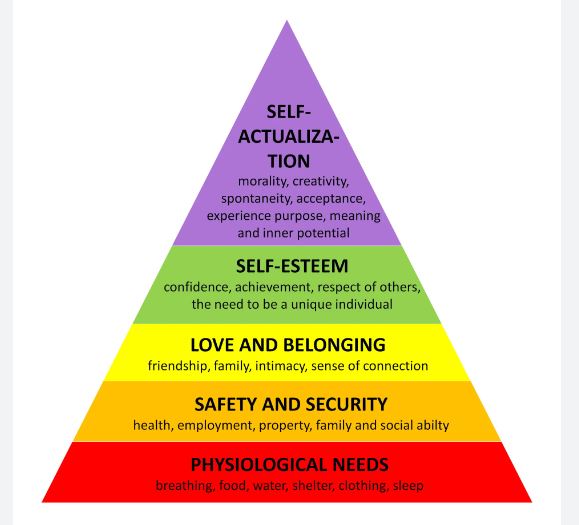
Human Needs: From Maslow’s Pyramid to Projective Mechanics The Deconstruction of Motivational Models and the Mechanics of Guided Real Experiences (By Alberto Bonizzato – Behavioral Coach) Within the contemporary pedagogical and social landscape, the reference models presented to the individual tend to map out an identity baseline predicated on inadequacy, continuously fueling a feedback loop of impotence and guilt. Within the Italo-European cultural framework, this dynamic historically translates into a state of victimistic passivity and self-commiseration, consolidating the archetype of the "anti-hero." Conversely, within the Anglophone narrative tradition—deeply influenced by the Protestant work ethic—one observes an opposite polarization: the originally low-status subject undergoes a functional transition, transforming into an active, socially acclaimed hero. From an anthropological and representative mind-mechanics perspective, the heroic figure encodes the line of demarcation between the condition of the ordinary person—whose existential trajectory passively conforms to the mandates and task-lists of the collectivity—and the proactive individual who evolves and recalibrates their internal setup through the raw data of real-world experience. The heroic stereotype thus operates as a baseline model of personal evolution in perpetual negotiation with the social Variable X. The individual registers the vital stimulus carried by the heroic myth, deploying it as a projective device engineered to satisfy the systemic need for belonging and legitimacy. This specific core of necessity, which Abraham Maslow historically formalized among the foundational layers of his motivational pyramid, assumes a radical urgency within the identity architecture of the modern individual. The advent of digital media and absolute, permanent visibility has profoundly altered self-perception, forcing the limbic apparatus into a continuous, exhausting performance of its own social value. [HEROIC MYTH STIMULUS / ABSOLUTE VISIBILITY] │ ▼ [CULTURAL COMPENSATORY MANDATE] (Media-Driven Performance Pressure) │ ┌───────────────────────────────┴──────────────────────────────┐ ▼ ▼ [ITALO-EUROPEAN MODEL] [ANGLOPHONE MODEL] - Anti-Hero Posture - Active Hero Transition - Victimistic Passivity - Competitive Hyper-Performance - Circuitry of Guilt/Blame - Social Consensus Seeking The Deconstruction of Maslow: Need as a Model Deficit For decades, standard psychology has categorized human drives through the rigid taxonomy of "Maslow's Pyramid," implying a linear progression that chains the individual from physiological survival to safety, belonging, esteem, and ultimately, self-actualization. Under the scientific lens of POMM (Perspective of Observation of Mind Mechanics), this classical framing reveals itself as superficial and devoid of deterministic validity. The so-called "higher needs" of the modern individual are not intrinsic, universal, or trans-temporal drives; rather, they are variables strictly modulated by the conditioning of the primary entourage and the projective processes of the limbic system. A non-physiological need is not an innate property of the human being, but an automated compensation strategy engineered to mask deep emotional lacunae recorded within the Emotional Model.
|
Panel Menu
|
|
|
|
Panel Menu
|
1. The Genesis of Need: The Limbic Filter and Event Precursione The limbic system permanently dominates the organism's arousal indices and neurovegetative responses. Depending on how the primary emotional chains (fear or attraction) are activated, the cognitive mind never experiences empirical reality in its objectivity; it selectively isolates only the datasets pertinent to its current tonic apprehension. ・ The Precursione of Events: If a subject is structured upon an emotional housing of fear regarding interpersonal relationships, their system will activate long before the actual physical encounter. The neocortex, saturated by an alarm arousal, initiates a hyper-vigilant scan of the environment, tracking and objectifying threat or rejection signals even where none exist. ・ The Definition of Need: Whenever the organism experiences internal suffering—entirely generated by its own anticipatory projection—the mind triggers a logical calculation designed to eliminate the metabolic tension. In this exact operational search for a solution, the cortex names the perceived deficit and manufactures the construct of the need. While a physiological need (hunger, thirst, thermoregulation) finds a direct mechanical resolution through physical interaction with matter, needs generated by states of inadequacy, guilt, or inferiority follow a distorted loop. Because the mind cannot resolve an emotional lacuna through intellectual calculations, it projects the blame for its malaise onto external or internal factors, establishing a coercive chain of attempted changes. The need thus converts into an imperative necessity to modify something external (others' behaviors, partners, professional contexts, consumer goods) in an illusory attempt to soothe a self-produced virtual reality (projection) of which the subject possesses zero functional awareness. 2. Real Needs (Sources) vs. Projective Needs To establish a rigorous operational framework, POMM bifurcates the concept of need into two distinct macro-functional categories, completely excluding basic biological factors:
Functional CategoryEtiological OriginMechanical PurposeReal Needs (Sources)Derived directly from the structural deficits and memory tracks stored within the primary, familial Emotional Model.To replicate the parameters of the familiar model or to compensate for its structural lacunae by evolving new skills.Projective NeedsStructured as a rebound effect of neocortical projections and contemporary environmental feedback.To validate or invalidate the real-world efficacy of the internal Emotional Model within the external social theater. The individual who linearly replicates the instructions of their Emotional Model lives in a state of "mechanical well-being." In this configuration, even acute suffering or devaluation, provided they were pre-programmed by the familial unit as the ordinary baseline, are experienced as coherent and thus fail to trigger a disruptive limbic alarm. However, when the contemporary environment returns feedback of stark operational inefficacy, the mind instantly activates compensatory mechanisms. 3. The Misconception of Cultural Compensation and Deviated Symbolization Compensatory activity is originally triggered to fill a genuine deficit within the Model, but it is forced to execute its operations within a pre-determined socio-cultural and semiotic landscape. It is at this exact intersection that the great misconception of modern society takes root: 1. The Source Impulse: The individual experiences the internal pressure of a real or source need (e.g., a profound deficit of affective recognition or visibility within the original family unit). 2. The Cultural Realignment: The reference culture diverts the subject's energetic output toward a standardized projective need (e.g., corporate hierarchy climbing, academic validation, or hyper-consumption of material assets). 3. Deviated Symbolization: The subject executes an erroneous symbolic overlay, convincing themselves that achieving "social success" will automatically heal the "internal lacuna." The systemic failure of this operation is mathematically absolute because the two operational levels are entirely decoupled. The internal plane demands a proprioceptive realignment and a real-world evolution of emotional experiences; the projective plane, conversely, pursues actions and milestones that are culturally presumed to be functional, but are profoundly contradictory to the required compensation. The biological result is an individual who achieves peak external validation while continuing to internally experience the exact same foundational distress and isolation. 4. The Clinical Perspective of POMM: Guided Real Experiences (GRE) Within the behavioral practice of POMM, clinical intervention radically rejects the traditional psychological colloquium predicated on the intellectual discussion of the patient's self-reported "problems." In virtually all scenarios, the verbal narratives of the subject are mere rational cover-stories, defensive ideologies, and projective constructs engineered by the mind to convince the coach of the opposite of reality, thereby shielding the pathogenic model from modification. The operational action of POMM articulates itself along three precise axes: ・ Decommissioning of Pathology: The subject is completely removed from the framework of "curing an illness." The intervention aims to de-focalize conscious attention away from the symptomatic complex, disrupting the autocatalytic loop that feeds the distress. ・ The Coach as a Metacommunicative Radar: Because the patient deploys verbal language as a shield and an encrypted code to preserve their emotional dynamics, the coach operates as a radar detector. The coach disregards the logical content of the words, analyzing exclusively the metacommunicative and para-verbal signals: micro-facial expressions, fluctuations in vocal tone, somatic posture, and motor kinetics. ・ Guided Real Experiences (GRE / Esperienze Reali Guidate): The engine of evolution is action. Through specific, individualized, and strictly monitored relational exercises, the subject is guided to execute new empirical actions within the present coordinates. These experiences are engineered to demonstrate concrete, unvarnished operational skills, entirely decoupled from the pressure of performance or the necessity of environmental seduction. Real efficacy, validated through the body on the field, replaces the anticipatory-hypothetical abstractions dictated by fear, leading to the spontaneous dissolution of the pathological setup and the operational update of the Emotional Model. Attention-Seeking vs. Need: Mechanical and Diagnostic Demarcation It is of vital diagnostic importance not to commit the error of overlapping the concept of need with that of an attention-seeking request, despite the fact that both anchor their roots within the exact same urgency of the Emotional Model: the search for environmental feedback to confirm the subject's existential validity. The distinction resides entirely within the fine mechanics of their behavioral execution.
┌─── [NEED] ────────────────────> Complex Projection │ (Status, Objects, Ideologies) [ MODEL URGENCY ] ────────┤ │ └─── [ATTENTION-SEEKING REQUEST] ─────> Direct Relational Signal (Infantile Visibility Quota)
While a need configures itself as a mediated and highly complex projective strategy—an attempt to compensate for structural deficits through the acquisition of objects, social status, or ideological conformity—an attention-seeking request operates as an immensely more direct, primitive, and relational return signal, engineered solely to restore the specific quantitative "quota" of visibility internalized during infancy (e.g., their baseline of "10 units"). The line of demarcation is therefore not qualitative, but is strictly determined by three precise operational parameters: 1. The Intensity of the Limbic Alarm: Significantly more acute, immediate, and high-arousal within attention-seeking behaviors. 2. The Typology of Executed Behavior: Markedly manipulative, seductive, or permanently conflictual within attention-seeking requests. 3. The Frequency of the Feedback Loop: The subject requires continuous, short-term, and constant confirmation to prevent the immediate collapse of their homeostatic stability. Confusing a genuine need for evolutionary compensation with a chronic, habitual attention-seeking request results in completely missing the target of the intervention: it mistakes a structural deficit of operational skills for an excess of dependency on external feedback. Conclusion: The Pathway to Emotional Independence Human needs never constitute the prime cause of our actions; they are merely the warning lights of a profound emotional engine desperately attempting to balance its internal equations. Comprehending the geometric distinction between what the organism actually requires to complete and upgrade its model (the acquisition of concrete operational skills) and what it projectively pursues under the guise of a cultural mandate is the first, non-negotiable step toward emotional independence. Only by transitioning from hypothetical efficacy—predicated on fear, anticipatory calculations, and the mirror imitation of others—to verified real efficacy can the individual cease chasing imaginary needs and begin to actively govern their biological reality.
|
|
|
|
|

|
Sito di divulgazione e pubblicazione culturale
I contenuti pubblicati in questo sito sono di proprietà intellettuale di Alberto Bonizzato In collaborazione con: Laura De Biasi e D.ssa Maria Russo Contatto: alberto@non-psicologica.org |
|